Research Education
PerformanceLabsUK supplies third party tested research reference materials for in vitro laboratory and scientific research use only, not for human or veterinary use.
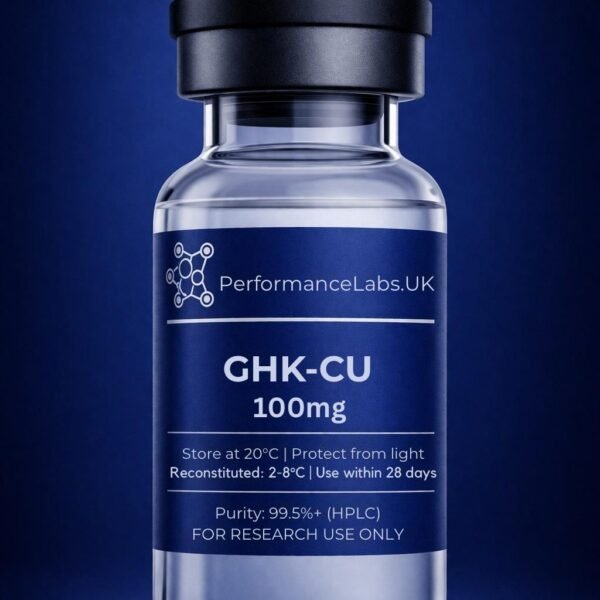
GHK-Cu is a naturally occurring copper-binding tripeptide that has been studied across a range of research areas, from tissue biology to dermal science. This page gives a general overview of what published literature examines when it comes to GHK-Cu, for research reference purposes only.
GHK-Cu is the copper complex of the tripeptide glycyl-histidyl-lysine (GHK). It was first identified in human plasma and has been observed to decline with age, which is part of why it has attracted research interest in tissue and cellular ageing studies. As a copper-binding peptide, it is often studied for its role in metal ion transport and related biochemical pathways.
Published literature on GHK-Cu spans several distinct research areas. These include studies on tissue remodelling and extracellular matrix biology, research into antioxidant activity and copper homeostasis, dermal research within cosmetic science literature, and gene expression studies examining how the peptide interacts with cellular signalling pathways. Each of these areas represents a distinct body of research rather than a single unified finding.
The copper-binding property of GHK-Cu is central to why it is studied. Copper is a cofactor for a number of metalloenzymes involved in tissue remodelling, and researchers have examined how the GHK-Cu complex may interact with these pathways at a cellular level. This remains an active area of published research rather than a settled mechanism.
| Research area | What published literature examines |
|---|---|
| Tissue remodelling | Interaction with extracellular matrix components and related cellular pathways |
| Antioxidant activity | Copper homeostasis and oxidative stress markers in cell-based studies |
| Dermal research | Cosmetic science literature examining skin-related cellular responses |
Certificate of Analysis libraryBrowse all reference materialsReconstitution calculatorMore research articles
Supplied for in vitro laboratory and scientific research use only. Not for human or veterinary use. Free UK delivery on orders over £75.

You must be 18 or over to enter this site.
WARNING: This website contains age-restricted content.
Join the list for new compound drops, batch COAs, and plain English research notes. Your code arrives straight away.
All products are supplied strictly for in vitro laboratory research use. Not for human or veterinary consumption.