KLOW Blend Research: A Comprehensive Technical Analysis of Multi-Peptide Synergies
Within the field of British peptide synthesis, the assumption that individual compounds behave identically when combined into a complex matrix is a significant oversight that compromises analytical validity. For those engaged in KLOW blend research, the shift from isolated substance study to multi-peptide synergy requires a disciplined approach to laboratory protocol. This is particularly relevant following the July 2026 FDA Pharmacy Compounding Advisory Committee recommendation; this vote to include BPC-157 and TB-500 in compounding discussions underscores the necessity for rigorous, data-driven inquiry into these specific sequences whilst they remain strictly for laboratory use.
You likely recognise that inconsistent batch purity and a lack of granular solubility data for complex blends create significant hurdles for reproducible results. This article provides a definitive technical guide to the composition and synergistic hypotheses of the KLOW multi-peptide complex. We will detail a rigorous protocol for reconstitution, explore the hypothesised pathways of its constituent peptides, and verify the sourcing standards necessary to maintain an ethical and transparent research environment in the UK.
Key Takeaways
- Identify the specific molecular constituents of the blend, including the 15-amino acid sequence of BPC-157 and the precise fragment of TB-500.
- Implement a rigorous reconstitution protocol using laboratory-grade Bacteriostatic Water to maintain chemical stability and prevent peptide degradation.
- Analyse the hypothesised biochemical synergies and complementary signalling pathways that define the current landscape of KLOW blend research.
- Master the interpretation of HPLC and Mass Spectrometry data to verify batch consistency and purity within a UK laboratory setting.
- Access the PerformanceLabsUK Ltd Peptide Research Handbook for comprehensive guidance on maintaining high-register standards for multi-compound reagents.
Defining the KLOW Blend in Contemporary Laboratory Research
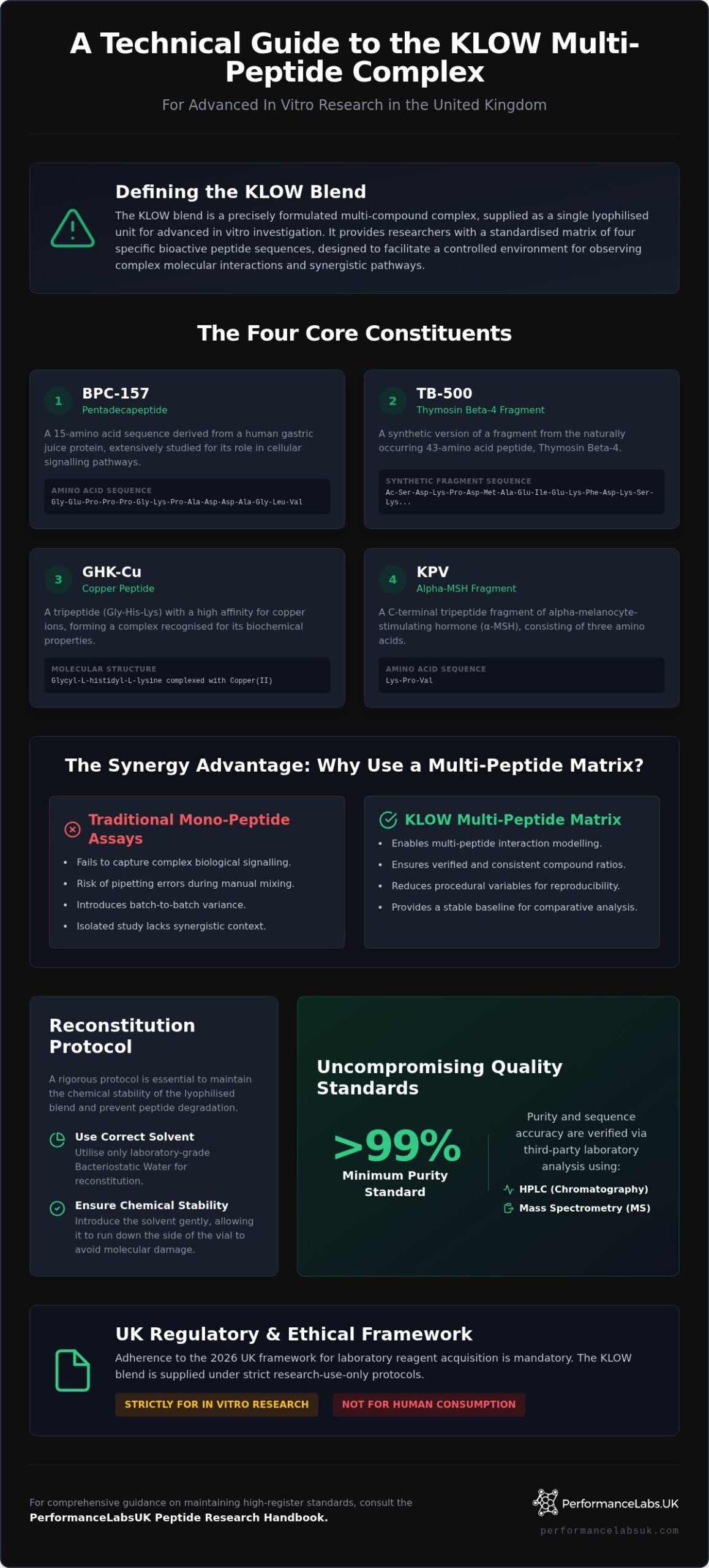
The KLOW blend represents a significant evolution in the procurement of specialised laboratory reagents. It is a precise multi-compound complex designed specifically for in vitro investigation, providing researchers with a standardised matrix of bioactive sequences. By consolidating these specific compounds into a single lyophilised unit, the blend facilitates a more controlled environment for observing molecular interactions. The standard composition of this proprietary formulation includes the following constituents:
- GHK-Cu (Copper Peptide)
- BPC-157 (Pentadecapeptide)
- TB-500 (Thymosin Beta-4 fragment)
- KPV (Lysine-Proline-Valine)
The Rationale for Multi-Peptide Complexes
Traditional mono-peptide assays often fail to capture the nuanced signalling pathways present in complex biological systems. Current KLOW blend research prioritises the shift from isolated substance study to multi-peptide interaction modelling. This approach allows researchers to investigate how complementary mechanisms might interact within a single assay environment. Using pre-blended lyophilised powders ensures that each constituent is present in a verified ratio, reducing the risk of pipetting errors or batch-to-batch variance that can occur during manual mixing. It’s a methodology that values analytical consistency over the variables introduced by separate compound preparation. Interaction modelling requires a stable baseline; by using a proprietary formulation, laboratories can ensure the ratios remain constant across multiple study phases.
Regulatory Context for UK Research Chemicals
Procurement within the United Kingdom must adhere strictly to the 2026 UK framework for laboratory reagent acquisition. This regulatory landscape demands a clear distinction between analytical grade compounds and therapeutic substances. Every batch of the KLOW blend is categorised strictly for research-use-only, meaning it’s not intended for human consumption or medical application. For those conducting KLOW blend research, compliance is maintained through documented protocols and rigorous sourcing standards. Professional laboratories must verify that their suppliers provide comprehensive documentation, such as HPLC and MS testing, to confirm that the reagents meet the required 99% purity thresholds. This adherence to protocol is a core component of maintaining the integrity of the UK research chemical supply chain. For detailed guidance on these standards, the PerformanceLabsUK Peptide Research Handbook serves as a critical educational tool for maintaining laboratory integrity.
Analytical Profiles of the KLOW Blend Constituents
The efficacy of KLOW blend research relies on the precise molecular characterisation of its four primary constituents. Each peptide’s been selected for its specific amino acid sequence and chemical profile to ensure a stable multi-compound matrix. BPC-157 is a pentadecapeptide composed of a 15-amino acid sequence (Gly-Glu-Pro-Pro-Pro-Gly-Lys-Pro-Ala-Asp-Asp-Ala-Gly-Leu-Val) derived from human gastric juice proteins. TB-500 is the synthetic version of the naturally occurring Thymosin Beta-4 fragment, specifically represented by the sequence Ac-Ser-Asp-Lys-Pro-Asp-Met-Ala-Glu-Ile-Glu-Lys-Phe-Asp-Lys-Ser-Lys-Leu-Lys-Lys-Thr-Glu-Thr-Gln-Glu-Lys-Asn-Pro-Leu-Pro-Ser-OH.
The blend also incorporates KPV, a C-terminal tripeptide fragment of alpha-melanocyte-stimulating hormone (alpha-MSH) consisting of Lys-Pro-Val. Finally, GHK-Cu, a tripeptide (Gly-His-Lys) complexed with copper, completes the reagent. Unlike isolated compounds, these peptides must maintain their structural integrity whilst co-existing in a single lyophilised vial. It’s this complex environment that demands high-register analytical standards to prevent cross-reactivity during storage.
Molecular Weight and Sequence Verification
Sequence accuracy is the cornerstone of experimental reproducibility. In KLOW blend research, even a single amino acid substitution can fundamentally alter the molecular weight and subsequent binding affinity of the compound. PerformanceLabsUK adheres to a minimum 99% purity standard, verified through High-Performance Liquid Chromatography (HPLC) and Mass Spectrometry (MS). These analytical methods ensure that the observed molecular weight matches the theoretical profile of the multi-peptide complex, confirming that no degradation occurred during the synthesis or blending process. For researchers requiring detailed batch specifications, consulting The PerformanceLabsUK Peptide Research Handbook provides the necessary technical data for rigorous protocol development.
GHK-Cu: The Role of Copper in Peptide Stability
The presence of GHK-Cu introduces unique chemical dynamics into the blend. As a copper-complexed tripeptide, its stability is governed by chelation dynamics, which can influence the overall solubility of the reagent. Extensive GHK-Cu peptide research suggests that the copper-peptide complex remains stable under specific pH conditions, yet its behaviour in a multi-compound environment requires careful monitoring. Chelation ensures the copper ion is properly sequestered within the Gly-His-Lys structure, preventing unwanted oxidative interactions with the other peptides like BPC-157 or KPV. In a controlled laboratory setting, maintaining a neutral pH during reconstitution is vital to preserve these chelation bonds and ensure the complex remains fully soluble for in vitro application.
Investigating Synergistic Mechanisms in Multi-Compound Systems
The hypothesis of synergy suggests that the biological efficacy of a multi-compound system exceeds the sum of its individual components. In the context of KLOW blend research, this principle’s applied to the investigation of complementary signalling pathways within cell-based assays. Researchers focus on the interaction between BPC-157 and Thymosin Beta-4 fragments, as these sequences appear to engage distinct but overlapping regenerative pathways. Whilst BPC-157 is frequently associated with the upregulation of growth factors, TB-500 (the Thymosin Beta-4 fragment) is known for its role in actin-sequestering and cell migration. Their simultaneous presence in a research model allows for a more nuanced observation of cellular behaviour than mono-peptide studies.
Similarly, the combination of KPV and GHK-Cu allows for the investigation of dual-pathway modulation regarding molecular markers of cellular stress. KPV, a tripeptide fragment of alpha-MSH, is often studied for its influence on inflammatory signalling; GHK-Cu supports the structural integrity of the extracellular matrix (ECM). The co-administration of these peptides in a single reagent provides a stable matrix for observing how cells maintain homeostasis under experimental pressure. There’s also the potential for enhanced reagent stability. Specific molecular bonding between the peptide sequences may improve the shelf-life and chemical resilience of the lyophilised powder during storage, provided the storage environment remains strictly controlled.
Cross-Pathway Interactions in In Vitro Models
Evaluating the impact of the KLOW blend on ECM studies requires a sophisticated understanding of cross-pathway interactions. Multi-peptide systems influence cellular signalling more effectively than isolates by simultaneously engaging multiple receptor sites. This is particularly relevant in mitochondrial assays, where the blend’s used to observe changes in metabolic efficiency and oxidative stress levels. Preliminary data suggests that the combined sequences in KLOW blend research provide a more robust signalling environment, potentially reducing the variance often seen in mitochondrial response studies. By using a standardised complex, laboratories can better model the multi-faceted nature of cellular communication.
Research Limitations and Current Gaps
Analytical integrity necessitates an acknowledgement of current research limitations. A primary gap exists in the availability of robust in vitro data regarding multi-peptide degradation rates in varied laboratory media. Addressing the challenges of isolating individual effects within a complex blend remains a significant hurdle; the synergistic effect can make it difficult to attribute specific cellular changes to a single peptide sequence. Future directions for KLOW blend research in UK laboratories will likely focus on advanced mass spectrometry techniques. These methods will be vital for tracking the individual kinetics of BPC-157, TB-500, KPV, and GHK-Cu whilst they exist within the same assay environment, ensuring that data remains precise and verifiable.
Protocols for Reconstitution, Solubility, and Chemical Stability
The transition of the KLOW complex from a stable lyophilised powder to an aqueous reagent is a critical juncture in any laboratory protocol. Precise reconstitution is fundamental to the success of KLOW blend research, as improper handling can lead to immediate peptide degradation or the formation of insoluble aggregates. To maintain the structural integrity of the constituent peptides, researchers must use laboratory-grade Bacteriostatic Water. This diluent, containing 0.9% benzyl alcohol, serves a dual purpose: it inhibits microbial growth whilst providing a stable medium for the multi-peptide matrix. Using non-sterile water or saline solutions with inappropriate pH levels can disrupt the delicate chelation bonds within the GHK-Cu complex or cause the premature oxidation of the BPC-157 sequence.
To ensure a homogenous solution and avoid peptide shear stress, follow this disciplined sequence:
- Allow the vial to reach room temperature before attempting reconstitution to prevent moisture condensation.
- Introduce the Bacteriostatic Water slowly by aiming the needle at the glass wall of the vial, allowing the liquid to trickle down.
- Don’t shake the vial; instead, use a gentle swirling motion until the powder’s completely dissolved.
- Verify that the resulting solution is clear and free of particulate matter before proceeding with the assay.
Maintaining Stability in Lyophilised and Reconstituted States
Long-term stability is contingent upon rigorous environmental control. Lyophilised vials should be stored in a specialised laboratory freezer at temperatures between -20°C and -80°C to preserve the amide bonds of the peptide sequences. Light and moisture are significant catalysts for degradation; therefore, vials must remain in a dark, desiccated environment. Once reconstituted, the chemical integrity of the KLOW complex diminishes rapidly. It’s best practice to use the solution within a 14-day window whilst keeping it refrigerated at 2°C to 8°C. Researchers must avoid multiple freeze-thaw cycles, as the resulting thermal stress can lead to significant multi-peptide blend degradation. For those requiring high-purity diluents for their protocols, you can source laboratory-grade Bacteriostatic Water to ensure consistent experimental results.
Solubility Challenges in Multi-Compound Systems
Multi-peptide systems present unique solubility profiles that differ from isolated compounds. GHK-Cu is generally highly soluble in aqueous media, yet BPC-157 can exhibit variable solubility depending on the final pH of the solution. Monitoring pH levels is essential to ensure the chemical integrity of the complex; a neutral range (pH 6.0 to 7.0) is typically optimal for maintaining the chelated state of the copper tripeptide. If the solution appears cloudy, it may indicate peptide precipitation or the presence of contaminants. Achieving uniform concentration across all aliquots requires a clear, homogenous solution. Signs of oxidation, such as a shift in the characteristic blue hue of the GHK-Cu, should be documented as they indicate a compromise in the reagent’s analytical validity. In KLOW blend research, these granular details often differentiate between reproducible data and experimental failure.
Establishing Quality Assurance and Batch Consistency Standards
Analytical verification’s the baseline for integrity in any professional laboratory environment. Within KLOW blend research, the complexity of managing a multi-peptide reagent necessitates a more rigorous testing protocol than that of isolated compounds. High-Performance Liquid Chromatography (HPLC) serves as the primary tool for verifying purity. This method separates the individual peptide sequences within the matrix, allowing for the precise quantification of GHK-Cu, BPC-157, TB-500, and KPV. A minimum 99% purity standard is the benchmark for these reagents; anything less introduces variables that can compromise in vitro data. Independent laboratory testing remains the gold standard because it provides an objective, third-party verification of the manufacturer’s claims, ensuring that batch consistency’s maintained across the UK supply chain.
Mass Spectrometry (MS) complements HPLC by providing a molecular fingerprint of the blend. Interpreting MS data for multi-peptide systems involves identifying the specific mass-to-charge ratios for each constituent. This process confirms that the intended sequences are present and haven’t undergone degradation during synthesis or lyophilisation. Traceability is equally vital. In the UK market, documented batch-specific reports are essential for establishing a clear chain of custody, allowing researchers to verify the origin and analytical profile of their reagents with absolute certainty.
Interpreting Analytical Reports
Reading a peptide purity chromatogram requires a disciplined eye for detail. A high-quality report displays a sharp, dominant peak for each peptide, with minimal baseline interference. Significant secondary peaks often indicate the presence of impurities or degradation products, such as truncated sequences or residual solvents. Analytical grade reagents are characterised by their high signal-to-noise ratio in the MS spectrum. When researchers identify these markers, they can be confident that the KLOW complex is chemically stable and suitable for sensitive molecular pathway investigation. Understanding these reports is a fundamental skill that prevents the use of sub-standard materials in professional research.
Sourcing Reliable Research Chemicals in the UK
The criteria for selecting a peptide supplier must centre on transparency and methodology. A reliable partner doesn’t merely promise quality; they provide the raw data to prove it. Ensuring supply chain transparency from the point of synthesis to laboratory delivery is a core responsibility of an ethical supplier. PerformanceLabsUK acts as a meticulous gatekeeper in this regard, prioritising protocol and documentation over market convenience. For those seeking to refine their laboratory techniques, the PerformanceLabsUK Peptide Research Handbook is a vital resource for establishing rigorous reconstitution and handling standards. This commitment to disclosure helps to eliminate the opacity often found in the research chemical industry.
Explore the KLOW Blend and Research Handbook at PerformanceLabsUK
Advancing Analytical Integrity in Multi-Peptide Systems
Advancing the landscape of KLOW blend research requires a disciplined adherence to analytical standards and handling protocols. We’ve established that the efficacy of multi-peptide systems depends on the precise molecular characterisation of constituents like BPC-157 and GHK-Cu. Maintaining chemical stability through the use of laboratory-grade Bacteriostatic Water and controlled storage conditions remains paramount for reproducible in vitro data. As the UK market continues to evolve, the distinction between high-purity reagents and inconsistent batches will define the success of contemporary laboratory inquiry.
Ensuring your research is supported by documented verification is the final step in establishing a rigorous methodology. PerformanceLabsUK provides the necessary transparency through independent HPLC and MS batch verification, maintaining strictly 99%+ purity standards for every unit. With dedicated UK-based research support, laboratories can proceed with confidence in the integrity of their materials.
Secure Analytical-Grade KLOW Blend for Your Research to ensure your assays are built upon a foundation of verifiable quality. We look forward to supporting your next phase of molecular investigation.
Frequently Asked Questions
What is the precise chemical composition of the KLOW blend?
The standard composition of this reagent includes four distinct peptide sequences: GHK-Cu (Copper Peptide), BPC-157 (Pentadecapeptide), TB-500 (the Thymosin Beta-4 fragment), and KPV (Lysine-Proline-Valine). These constituents are consolidated into a single lyophilised unit to facilitate consistent KLOW blend research. Each batch is formulated to a proprietary ratio, ensuring that molecular interactions remain standardised across varied in vitro assay environments whilst maintaining high-register analytical integrity.
How should the KLOW blend be stored to maintain maximum stability?
Stability is maintained by storing lyophilised vials in a specialised laboratory freezer at temperatures between -20°C and -80°C. Vials must be protected from light and moisture to prevent the premature degradation of amide bonds. Once the reagent’s reconstituted, it should be kept refrigerated at 2°C to 8°C and utilised within 14 days. Avoid multiple freeze-thaw cycles, as thermal stress significantly compromises the chemical integrity of the multi-peptide complex.
What is the recommended reconstitution protocol for this multi-peptide complex?
The protocol begins by allowing the vial to reach room temperature to avoid condensation. Introduce laboratory-grade Bacteriostatic Water slowly by aiming the needle at the glass wall, allowing the diluent to trickle down. You don’t shake the vial; instead, use a gentle swirling motion until the powder’s completely dissolved. This meticulous approach prevents peptide shear stress and ensures a homogenous solution for accurate concentration across all laboratory aliquots.
Can the KLOW blend be used for human consumption or therapeutic purposes?
No, the KLOW complex is strictly designated for research-use-only and is not intended for human consumption or therapeutic application. PerformanceLabsUK provides these compounds exclusively for in vitro and laboratory investigation within the UK. The brand maintains a rigorous boundary between analytical research and medical use, ensuring that all procurement adheres to the 2026 UK framework for laboratory reagent acquisition and documented research-only protocols.
Why is GHK-Cu included in the KLOW blend research formulation?
GHK-Cu is included to facilitate the study of extracellular matrix (ECM) dynamics and synergistic molecular bonding. As a copper-complexed tripeptide, its presence allows researchers to investigate dual-pathway modulation when combined with sequences like BPC-157. In the context of KLOW blend research, GHK-Cu serves as a vital marker for observing cellular homeostasis and metabolic efficiency in mitochondrial assays, providing a robust signalling environment that isolates alone cannot replicate.
How does PerformanceLabsUK verify the purity of its KLOW blend batches?
Verification is achieved through independent High-Performance Liquid Chromatography (HPLC) and Mass Spectrometry (MS) testing. These analytical methods separate the constituent peptides and provide a molecular fingerprint to confirm sequence accuracy. Every batch must meet a minimum 99% purity standard to be cleared for laboratory distribution. This process ensures traceability and provides researchers with batch-specific documentation that verifies the analytical grade of the multi-peptide complex.
What are the legal requirements for purchasing research peptides in the UK?
Purchasing reagents in the United Kingdom requires strict adherence to the 2026 regulatory framework for laboratory chemicals. Reagents must be clearly distinguished from medicinal products and used exclusively for analytical or research purposes. Buyers are responsible for ensuring that their laboratory facilities meet the necessary standards for handling such compounds. Documented research-use-only status is mandatory, and suppliers must provide supply chain transparency from synthesis to delivery to maintain legal compliance.
Is Bacteriostatic Water necessary for the reconstitution of the KLOW blend?
Yes, laboratory-grade Bacteriostatic Water is necessary to ensure the chemical stability of the aqueous reagent. The 0.9% benzyl alcohol content inhibits microbial growth, which is critical for maintaining the integrity of multi-peptide matrices over a 14-day period. Using non-sterile diluents or water with inappropriate pH levels can disrupt chelation bonds and lead to peptide oxidation. Using the correct diluent ensures the solution remains clear, homogenous, and analytically valid.

Age Verification Required
You must be of legal age to enter this site.
WARNING: This website contains age-restricted content.