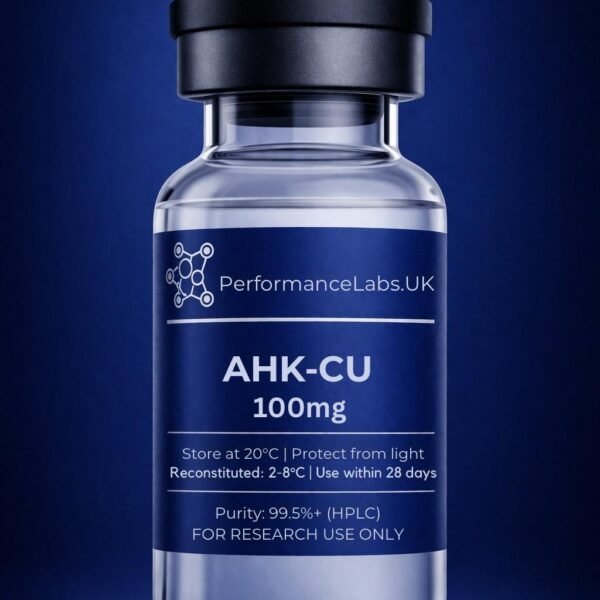
This page summarises findings from published academic literature. It does not describe or endorse use in humans or animals.
AHK-Cu is almost always studied alongside GHK-Cu rather than instead of it. That is not an accident of how the literature developed. The comparison is the experiment.
AHK-Cu is a tripeptide, alanyl-histidyl-lysine, complexed with copper. GHK-Cu is glycyl-histidyl-lysine with copper.
The two differ at a single position. Glycine, the smallest amino acid with just a hydrogen atom as its side chain, is replaced by alanine, which has a methyl group instead. Everything else is identical, including the histidine and lysine residues that coordinate the copper ion.
That is a very small structural change, and it is precisely why the pair is useful.
Comparative structure-activity work. The largest share. Published research examines what changes, and what does not, when glycine is substituted for alanine at the N-terminus while copper coordination is preserved.
Extracellular matrix research. Both peptides appear in literature examining fibroblast behaviour and matrix protein expression in dermal cell models.
Copper coordination chemistry. Work examining the binding geometry of the copper ion and the stability of the complex under different conditions. This is chemistry rather than cell biology, and it is a substantial part of the literature.
Hair follicle cell models. A smaller body of published work examines AHK-Cu specifically in follicular cell models.
Structure-activity relationship research works by changing one thing and observing what follows. The difficulty is that most peptide comparisons change several things at once, which makes attribution impossible.
GHK-Cu and AHK-Cu are an unusually clean pair. One residue differs, and it is the residue least likely to be doing something complicated, because glycine has essentially no side chain to speak of.
So when published work reports a difference between them, the range of possible explanations is narrow: the additional methyl group, its effect on the local conformation, or its effect on how the copper is coordinated. That is a tractable question in a field where most questions are not.
It is also worth understanding what these compounds are and are not. The copper is not incidental packaging. In the published literature the peptide and the metal are studied as a unit, because the coordination chemistry is part of what is being examined. Describing either compound as simply a peptide, with copper as an additive, misreads the research.
| Attribute | GHK-Cu | AHK-Cu |
|---|---|---|
| Sequence | Glycyl-histidyl-lysine | Alanyl-histidyl-lysine |
| N-terminal residue | Glycine (hydrogen side chain) | Alanine (methyl side chain) |
| Copper coordination | Via histidine and lysine residues | Via histidine and lysine residues |
| Published literature volume | Substantial and long-established | Smaller, largely comparative |
One amino acid. AHK-Cu has alanine at the N-terminal position where GHK-Cu has glycine. The remaining two residues and the copper coordination are the same.
Because it isolates a variable. Most peptide comparisons change several structural features at once, which makes it impossible to attribute an observed difference to any one of them. A single-residue difference narrows the possible explanations considerably.
Part of it. In the published literature the peptide and the copper ion are studied as a coordinated complex, and the coordination chemistry is itself a research subject.
No. AHK-Cu is not a licensed medicine in the United Kingdom. PerformanceLabsUK is not a pharmacy, a pharmaceutical company or a medical provider.
No. All compounds discussed on this site are supplied strictly for in vitro laboratory research use only, and are not intended for human or animal administration.
No. This page is provided for educational purposes only and does not constitute medical advice. Consult a qualified healthcare professional for any medical concern.
Compounds studied in this area are listed under Copper and Dermal Research Peptides.
PerformanceLabsUK Ltd supplies third party tested research reference materials for in vitro laboratory investigation. We are not a pharmacy, pharmaceutical company, or medical provider. All products are supplied for research use only.
Certificate of Analysis libraryBrowse all reference materialsReconstitution calculatorMore research articles
Supplied for in vitro laboratory and scientific research use only. Not for human or veterinary use. Free UK delivery on orders over £75.

You must be 18 or over to enter this site.
WARNING: This website contains age-restricted content.