This page summarises findings from published academic literature. It does not describe or endorse use in humans or animals.
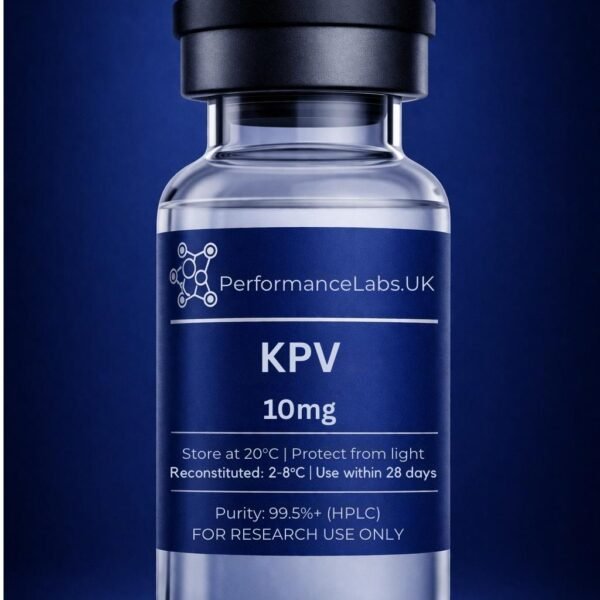
KPV is a tripeptide, three amino acids long: lysine, proline, valine. It is the C-terminal fragment of alpha-melanocyte stimulating hormone, and it is one of the clearest examples in the peptide literature of a very small fragment retaining signalling characteristics associated with a much larger parent molecule.
Alpha-MSH is a thirteen amino acid hormone with a broad research literature covering pigmentation, energy balance and inflammatory signalling. KPV is the last three residues of that sequence.
The size difference matters, and it is why KPV became a research subject in its own right rather than a footnote to alpha-MSH. A tripeptide is a fundamentally different molecule to work with. It is more stable, it is cheaper to synthesise, and its behaviour in cell models is easier to attribute because there are fewer structural features that could account for what is observed.
Published research examines whether the anti-inflammatory signalling associated with alpha-MSH is retained by the fragment, and if so, which structural feature is responsible.
Epithelial and gut biology. The largest share of the KPV literature examines intestinal epithelial cell models. Published work looks at inflammatory signalling in those models and at how a small peptide behaves in an epithelial context.
Inflammatory pathway research. KPV appears in studies examining NF-kB associated signalling and cytokine expression in cell models. It is generally used as a probe for the pathway rather than as the object of study.
Melanocortin receptor research. KPV is examined for how much of its observed activity depends on melanocortin receptor binding and how much occurs independently of it. That question is unresolved in the literature and is one of the more interesting open threads.
Wound and tissue models. A smaller body of work examines KPV in dermal and tissue repair models, which is why it appears alongside BPC-157 and TB-500 in the multi-peptide research literature.
Peptide research has a recurring structural problem: when a large molecule does several things at once, it is difficult to work out which part of it is responsible for which.
Fragments are how researchers approach that. Take the parent molecule, isolate a section, and observe what survives.
KPV is a good case because the fragment is so short. Three residues is close to the minimum at which a peptide can be said to have a sequence at all. If activity associated with a thirteen amino acid hormone is still observable in three of its residues, that narrows the structural question considerably.
This is also why KPV appears in the literature alongside compounds it otherwise has little in common with. It is studied as a structural question as much as a biological one.
| Attribute | Alpha-MSH | KPV |
|---|---|---|
| Length | 13 amino acids | 3 amino acids (Lys-Pro-Val) |
| Origin | Endogenous hormone | C-terminal fragment of alpha-MSH |
| Published research breadth | Pigmentation, energy balance, inflammatory signalling | Predominantly inflammatory and epithelial models |
| Typical research model | Cell and animal models | Cell models, particularly intestinal epithelial |
No. KPV is a three amino acid fragment of the thirteen amino acid alpha-MSH sequence. They are structurally distinct molecules with overlapping but separate research literatures.
Because its length is the research question. Isolating a short fragment and observing what activity persists is a standard method for narrowing down which part of a larger molecule accounts for an observed effect.
No. KPV is not a licensed medicine in the United Kingdom. PerformanceLabsUK is not a pharmacy, a pharmaceutical company or a medical provider.
No. All compounds discussed on this site are supplied strictly for in vitro laboratory research use only, and are not intended for human or animal administration.
No. This page is provided for educational purposes only and does not constitute medical advice. Consult a qualified healthcare professional for any medical concern.
Compounds studied in this area are listed under Tissue Remodelling Research Peptides.
PerformanceLabsUK Ltd supplies third party tested research reference materials for in vitro laboratory investigation. We are not a pharmacy, pharmaceutical company, or medical provider. All products are supplied for research use only.
Certificate of Analysis libraryBrowse all reference materialsReconstitution calculatorMore research articles
Supplied for in vitro laboratory and scientific research use only. Not for human or veterinary use. Free UK delivery on orders over £75.

You must be 18 or over to enter this site.
WARNING: This website contains age-restricted content.