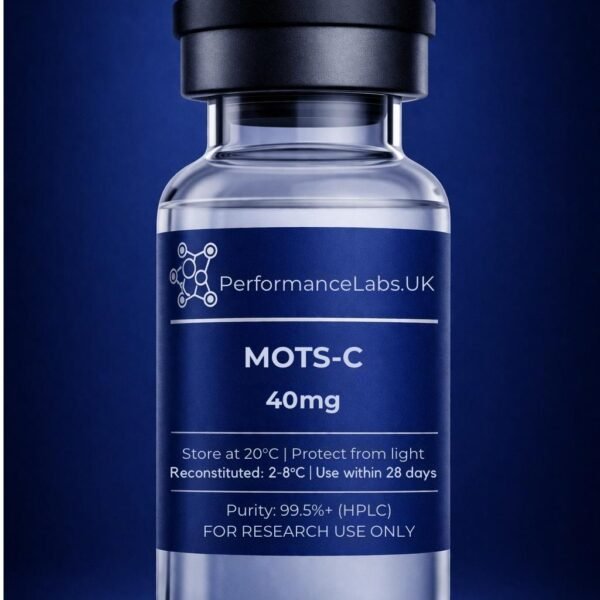
This page summarises findings from published academic literature. It does not describe or endorse use in humans or animals.
Almost every peptide in the research literature is encoded in the nuclear genome. MOTS-c is not. It is encoded within mitochondrial DNA, and that single fact is why it became a research subject.
MOTS-c is a short peptide encoded within the 12S ribosomal RNA gene of mitochondrial DNA. The name stands for mitochondrial open reading frame of the twelve S rRNA type-c.
Mitochondria carry their own small circular genome, a remnant of their bacterial origin, containing only a handful of genes. For a long time that genome was understood to encode components of the respiratory chain and the machinery to build them, and nothing else.
The discovery that short peptides are also encoded there, within sequences already known to code for something else, changed how the mitochondrial genome is read. MOTS-c is one of a small number of such peptides identified so far.
Retrograde signalling. The central research question. Conventional signalling runs from nucleus to mitochondrion. A peptide encoded in mitochondrial DNA that acts elsewhere in the cell runs the other way, and published work examines what that implies for how the two genomes coordinate.
Metabolic pathway research. MOTS-c appears in literature examining AMPK-associated signalling and folate-methionine pathway interactions in cell models.
Exercise and stress response models. Published research examines changes in MOTS-c levels under metabolic stress conditions in animal models. This is observational work about correlation, not about mechanism.
Ageing biology. MOTS-c appears in the mitochondrial theory of ageing literature, generally as one input among many.
The reason MOTS-c gets attention is conceptual rather than pharmacological.
If mitochondria encode peptides that act outside the mitochondrion, then they are not simply organelles that respond to instructions. They are participants in cellular signalling with their own genetic contribution. That reframes a compartment that had been understood mainly in terms of energy production.
The practical research consequence is that mitochondrial-derived peptides are hard to study by conventional means. They are encoded within sequences that already have another function, so standard approaches for isolating gene function do not apply cleanly. Much of the published work is therefore methodological, and a good deal of it is contested.
Anyone reading this literature should expect a field that is younger and less settled than, say, the growth hormone axis literature. That is not a criticism of the work. It is a description of where the field currently is.
| Attribute | Typical research peptide | MOTS-c |
|---|---|---|
| Encoded in | Nuclear genome | Mitochondrial DNA, within the 12S rRNA gene |
| Signalling direction studied | Nucleus outward | Mitochondrion outward (retrograde) |
| Maturity of literature | Often decades | Comparatively recent and actively contested |
| Typical research model | Cell and animal models | Cell and animal models, with significant methodological work |
Its origin. MOTS-c is encoded within mitochondrial DNA rather than the nuclear genome, which makes it one of a small number of known mitochondrial-derived peptides.
Signalling that runs from the mitochondrion outward to the rest of the cell, rather than from the nucleus inward. A peptide encoded in mitochondrial DNA that acts elsewhere in the cell is studied as an example of it.
No. MOTS-c is not a licensed medicine in the United Kingdom. PerformanceLabsUK is not a pharmacy, a pharmaceutical company or a medical provider.
No. All compounds discussed on this site are supplied strictly for in vitro laboratory research use only, and are not intended for human or animal administration.
No. This page is provided for educational purposes only and does not constitute medical advice. Consult a qualified healthcare professional for any medical concern.
Compounds studied in this area are listed under Mitochondrial Research Peptides.
PerformanceLabsUK Ltd supplies third party tested research reference materials for in vitro laboratory investigation. We are not a pharmacy, pharmaceutical company, or medical provider. All products are supplied for research use only.
Certificate of Analysis libraryBrowse all reference materialsReconstitution calculatorMore research articles
Supplied for in vitro laboratory and scientific research use only. Not for human or veterinary use. Free UK delivery on orders over £75.

You must be 18 or over to enter this site.
WARNING: This website contains age-restricted content.