This page summarises findings from published academic literature. It does not describe or endorse use in humans or animals.
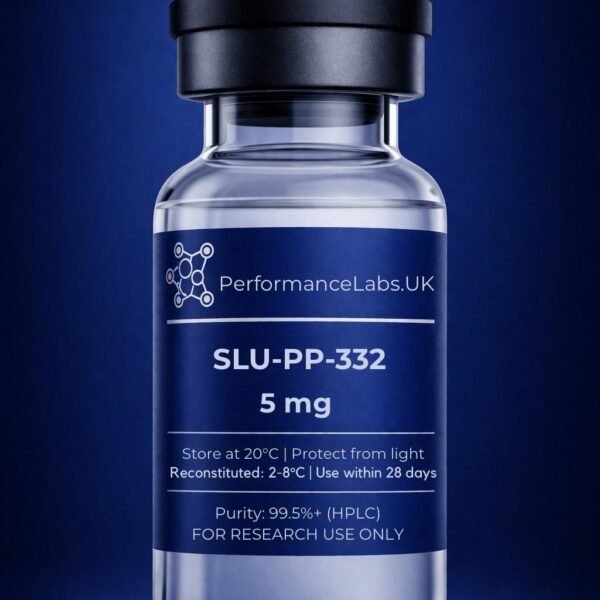
SLU-PP-332 is the odd one out in this catalogue. Almost everything else is a peptide. This is a small synthetic molecule, and it acts on a class of receptor that behaves very differently to the surface receptors most peptide research concerns.
SLU-PP-332 is a synthetic agonist of the oestrogen-related receptors, a family comprising ERRα, ERRβ and ERRγ. The name comes from Saint Louis University, where the compound series originated.
The oestrogen-related receptors are worth explaining, because the name is misleading. They are named for their structural resemblance to the oestrogen receptor, not for a shared function. They do not bind oestrogen. They are classed as orphan nuclear receptors, meaning no endogenous ligand has been established for them.
That distinction matters and it is routinely lost in secondary coverage of this compound.
Transcriptional regulation. The central subject. As nuclear receptors, the ERRs act as transcription factors, binding DNA directly and regulating gene expression rather than triggering a signalling cascade at the cell surface.
Oxidative metabolism gene programmes. Published research examines ERR activation and the expression of genes associated with mitochondrial biogenesis and oxidative metabolism in cell models.
Receptor subtype selectivity. Work examining activity across ERRα, ERRβ and ERRγ, and what differential engagement of the three implies.
Metabolic research models. SLU-PP-332 appears in animal model literature examining metabolic parameters. It is frequently described in secondary coverage as an “exercise mimetic”. That phrase belongs to press write-ups rather than to the primary literature, and it should be treated with caution.
Most peptide research concerns receptors sitting in the cell membrane. A ligand binds outside, a conformational change propagates inward, and a signalling cascade follows. Effects are often measurable in seconds to minutes.
Nuclear receptors work differently. They sit inside the cell, and on activation they bind directly to DNA and change which genes are transcribed. There is no cascade in the same sense. The receptor is the transcription factor.
Three consequences follow for anyone reading this literature.
Timescales are longer. Transcriptional changes take hours, and downstream protein-level changes longer still. Study designs reflect that.
Effects are broad. A transcription factor regulates many genes at once. Isolating any single consequence is correspondingly harder.
Cell type matters enormously. The same receptor activation produces different transcriptional outcomes depending on what else is present in the cell. A result in one cell line transfers to another far less readily than in receptor-cascade research.
| Attribute | Cell surface receptors | Nuclear receptors including ERRs |
|---|---|---|
| Location | Cell membrane | Intracellular |
| Mechanism studied | Ligand binding triggers a signalling cascade | Receptor binds DNA and regulates transcription directly |
| Typical timescale in published work | Seconds to minutes | Hours to days |
| Transferability between cell types | Comparatively higher | Low. Outcome depends heavily on cellular context |
No. It is a small synthetic molecule. Most of the PerformanceLabsUK catalogue is peptides, and this compound is an exception.
No. They are named for structural similarity to the oestrogen receptor, not for shared function. They are orphan nuclear receptors, meaning no endogenous ligand has been established for them.
That phrase comes from press coverage rather than from the primary research literature. The published work examines transcriptional regulation of oxidative metabolism gene programmes in cell and animal models. Any broader characterisation should be treated as secondary interpretation.
No. SLU-PP-332 is not a licensed medicine in the United Kingdom. PerformanceLabsUK is not a pharmacy, a pharmaceutical company or a medical provider.
No. All compounds discussed on this site are supplied strictly for in vitro laboratory research use only, and are not intended for human or animal administration.
No. This page is provided for educational purposes only and does not constitute medical advice. Consult a qualified healthcare professional for any medical concern.
Compounds studied in this area are listed under Metabolic Research Peptides.
PerformanceLabsUK Ltd supplies third party tested research reference materials for in vitro laboratory investigation. We are not a pharmacy, pharmaceutical company, or medical provider. All products are supplied for research use only.
Certificate of Analysis libraryBrowse all reference materialsReconstitution calculatorMore research articles
Supplied for in vitro laboratory and scientific research use only. Not for human or veterinary use. Free UK delivery on orders over £75.

You must be 18 or over to enter this site.
WARNING: This website contains age-restricted content.