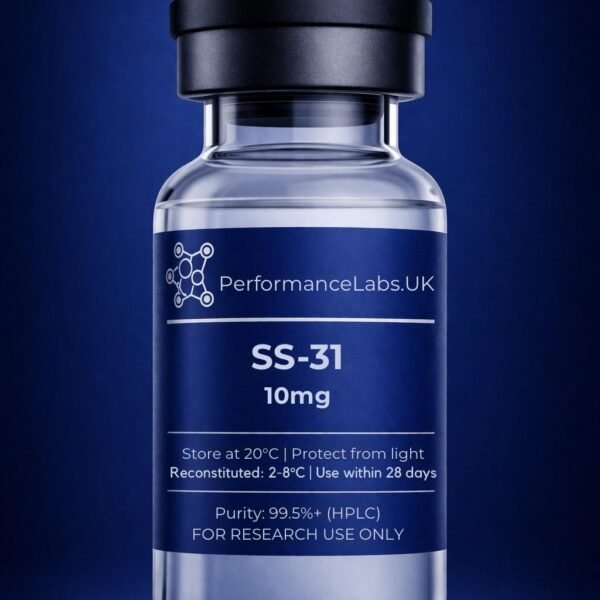
This page summarises findings from published academic literature. It does not describe or endorse use in humans or animals.
Most compounds studied in cell biology reach their target by diffusing until they encounter something they bind to. SS-31 is studied because it appears to do something more specific: concentrate at one membrane, inside one organelle, through interaction with one lipid.
SS-31 is a synthetic tetrapeptide, four amino acids long, developed by Hazel Szeto and Peter Schiller. The SS in the name is their initials, and the 31 is a compound number from the development series.
Its sequence is D-Arg-2′,6′-dimethylTyr-Lys-Phe-NH2. Two features of that sequence account for most of the research interest.
It is alternating cationic and aromatic, which is the structural pattern associated with its membrane affinity. And it contains a D-amino acid, the mirror image of the naturally occurring L form. Biological systems are built around L-amino acids, so a D-residue substantially changes how the peptide is handled.
Cardiolipin interaction. The central subject. Cardiolipin is a phospholipid found almost exclusively in the inner mitochondrial membrane, which makes it an unusually specific address. Published research examines SS-31’s affinity for it and what follows from that association.
Electron transport chain research. Work examining whether cardiolipin association affects the organisation and efficiency of respiratory chain complexes in cell models.
Oxidative stress models. SS-31 appears in literature examining reactive oxygen species production in mitochondria under stress conditions in cell and animal models.
Mitochondrial morphology. A smaller body of work examines cristae structure, the folded architecture of the inner membrane, where cardiolipin has a recognised structural role.
Mitochondria are difficult to reach. A compound has to cross the cell membrane, then the outer mitochondrial membrane, then reach the inner membrane, which is the most selective barrier in the organelle.
Most approaches to that problem use charge. The inner mitochondrial membrane maintains a strong negative potential, so positively charged molecules accumulate there. The limitation is that this is a property of the compartment, not of a particular structure within it, and it depends on the membrane potential being intact, which is often exactly what is disrupted in the models people want to study.
Cardiolipin association is a different approach. Cardiolipin is a structural component rather than an electrical property, so association with it does not depend on the membrane potential in the same way. In the published literature this is presented as the more precise targeting strategy, and it is the reason SS-31 is described as one of the more specifically directed mitochondrial compounds under investigation.
| Approach | Basis | Published research consideration |
|---|---|---|
| Charge-based accumulation | Membrane potential of the inner mitochondrial membrane | Depends on potential being intact, which is often the variable under study |
| Cardiolipin association | Binding to a structural lipid of the inner membrane | Does not depend on membrane potential in the same way |
| Untargeted compounds | Diffusion | Reaching the inner membrane at all is the limiting factor |
SS is for Szeto and Schiller, the researchers who developed the compound series. 31 is the compound number within that series.
Cardiolipin is a phospholipid found almost exclusively in the inner mitochondrial membrane. That near-exclusivity is what makes it interesting as a target: association with it implies location within a specific compartment rather than general distribution.
No. SS-31 is not a licensed medicine in the United Kingdom. PerformanceLabsUK is not a pharmacy, a pharmaceutical company or a medical provider.
No. All compounds discussed on this site are supplied strictly for in vitro laboratory research use only, and are not intended for human or animal administration.
No. This page is provided for educational purposes only and does not constitute medical advice. Consult a qualified healthcare professional for any medical concern.
Compounds studied in this area are listed under Mitochondrial Research Peptides.
PerformanceLabsUK Ltd supplies third party tested research reference materials for in vitro laboratory investigation. We are not a pharmacy, pharmaceutical company, or medical provider. All products are supplied for research use only.
Certificate of Analysis libraryBrowse all reference materialsReconstitution calculatorMore research articles
Supplied for in vitro laboratory and scientific research use only. Not for human or veterinary use. Free UK delivery on orders over £75.

You must be 18 or over to enter this site.
WARNING: This website contains age-restricted content.