Peptide Purity Verification: A Researcher’s Guide to HPLC and MS Analysis
A standard High-Performance Liquid Chromatography (HPLC) report is often treated as an absolute guarantee of quality, yet in an opaque market, a static PDF is frequently the weakest link in the scientific chain of custody. You likely recognise the frustration of encountering inconsistent batch quality or recycled certificates of analysis that lack genuine traceability. In the UK research sector, where compounds such as the KLOW Blend or Retatrutide demand absolute precision, relying on surface-level claims poses a significant threat to the integrity of your laboratory data.
This guide provides the rigorous analytical framework necessary to master peptide purity verification, ensuring you can independently validate the chemical identity of your research compounds with clinical certainty. Whilst independent testing typically costs approximately £300 for basic HPLC and MS identity confirmation, the cost of compromised data is far higher. We will examine the technical nuances of Mass Spectrometry, establish a strict protocol for reading COAs according to 2026 standards, and outline the methodology required to ensure every compound meets the 98% purity threshold essential for robust in vitro research.
Key Takeaways
- Distinguish between High-Performance Liquid Chromatography for purity assessment and Mass Spectrometry for identity confirmation to ensure comprehensive compound validation.
- Master the analytical frameworks of peptide purity verification by learning to interpret HPLC peak area analysis and LC-MS intact mass measurements for rigorous research.
- Identify the five essential components of a legitimate Certificate of Analysis (COA) to establish direct traceability between a vial’s batch number and its specific laboratory report.
- Recognise critical red flags in marketing claims, including redacted laboratory identities and the use of singular reports to cover inconsistent batch cycles.
- Organise your laboratory sourcing protocol using the PerformanceLabsUK Ltd Peptide Research Handbook to ensure all research compounds meet the 2026 standards for transparency.
What is Peptide Purity Verification in a Research Context?
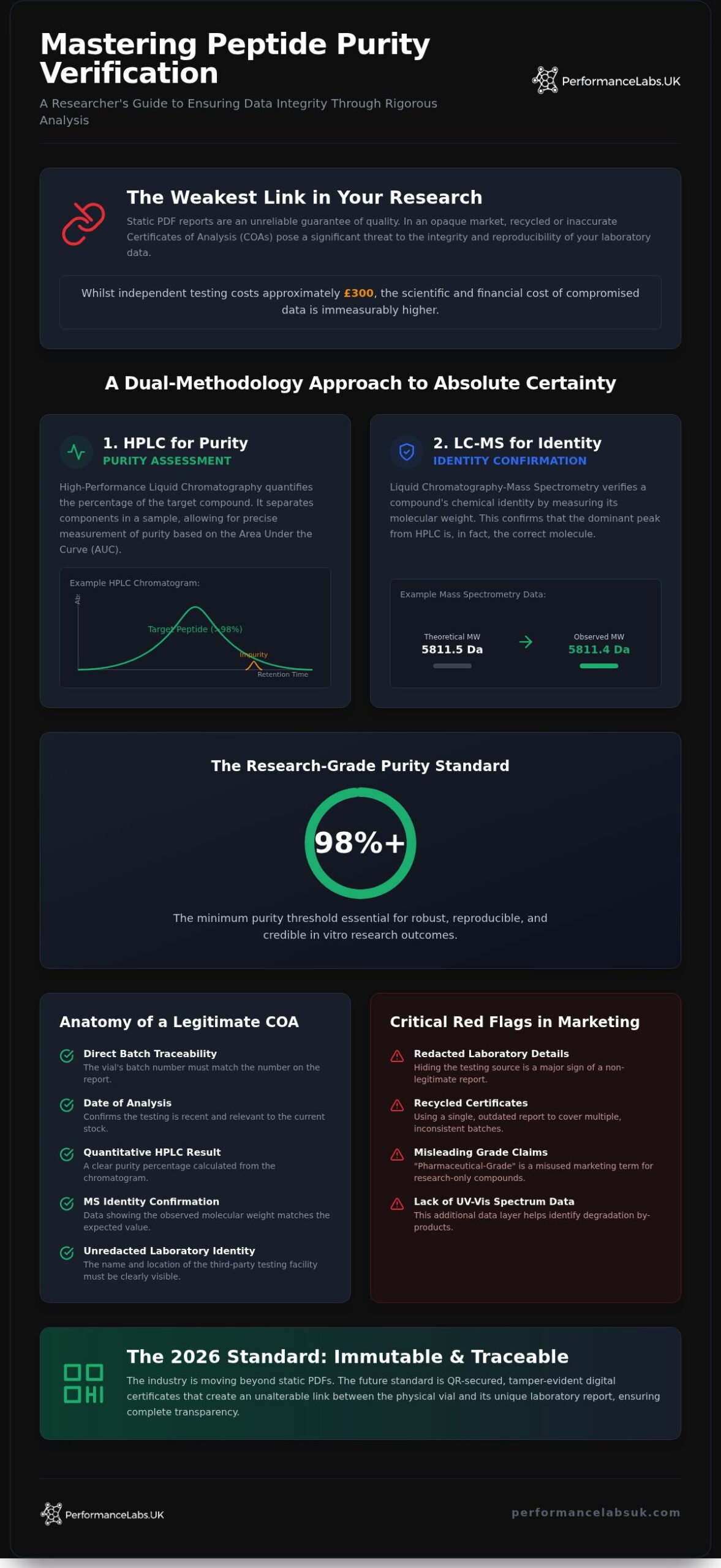
Peptide purity verification represents the rigorous analytical protocol used to establish both the chemical identity and the quantitative percentage of a target compound within a given sample. In the context of laboratory reagents, this process is not a singular test but a dual-layered validation. High-Performance Liquid Chromatography (HPLC) is utilised to determine the purity percentage by measuring the relative peak area of the target molecule against any detected impurities. However, purity alone is insufficient without confirmation of identity. This is achieved through Protein Mass Spectrometry, which verifies that the molecular weight of the compound aligns exactly with its theoretical sequence. Establishing a consistent standard for peptide purity verification is the only reliable method to ensure that the chemical identity matches the intended research objective.
By 2026, the industry standard for this verification has evolved from static PDF reports to QR-secured, tamper-evident digital certificates. These advancements ensure that the data provided by the laboratory remains immutable and directly traceable to the specific batch in the researcher’s possession. This shift reflects a broader commitment to transparency within the UK research sector, where the integrity of a compound must be beyond reproach to maintain scientific credibility.
The Role of Verification in Scientific Integrity
The absence of verified reagents introduces variables that compromise the reproducibility of in vitro studies. Unverified compounds often contain residual solvents or truncated sequences that induce false-positive results in sensitive assays. For mitochondrial research involving compounds like NAD+ or SS-31, even minor contaminants can alter metabolic pathways. Ensuring the molecular weight matches the theoretical sequence guarantees that observed biological activity is attributable to the intended peptide.
Research-Grade vs. Pharmaceutical-Grade Standards
In the UK market, ‘Research-Grade’ defines a compound synthesised for experimental use with documented analytical profiles. Suppliers frequently misuse ‘Pharmaceutical-Grade’ as a marketing claim; however, pharmaceutical standards involve regulatory pathways that do not apply to laboratory reagents. Maintaining a strictly research-use-only policy is required by the Human Medicines Regulations 2012. Documentation found in the PerformanceLabsUK Peptide Research Handbook prioritises transparent data, ensuring researchers can rely on compounds like Retatrutide GLP-3.
Analytical Methodologies: HPLC and LC-MS Explained
Relying on a single analytical method introduces unacceptable risk in high-stakes laboratory research. For complex compounds like Retatrutide GLP-3, a robust peptide purity verification protocol must integrate both High-Performance Liquid Chromatography (HPLC) and Liquid Chromatography-Mass Spectrometry (LC-MS). HPLC excels at quantifying the percentage of the target compound, but it cannot confirm if that compound is chemically correct. Conversely, LC-MS provides the molecular weight and structural identity but is less precise for quantifying minor impurities. The modern standard for peptide purity verification relies on this dual-instrumental approach to mitigate the risk of using misidentified or degraded reagents. The inclusion of the UV-Vis spectrum provides an additional layer of security, allowing researchers to identify degradation by-products that may not be immediately apparent through mass alone. Monitoring at specific wavelengths, such as 214nm, ensures that peptide bonds are accurately detected across the entire gradient.
Interpreting HPLC Chromatograms
A legitimate HPLC report displays a chromatogram where the x-axis represents retention time and the y-axis indicates absorbance. In a high-purity sample, a singular, sharp peak should dominate the graph. Multiple smaller peaks, or “shoulders” on the primary peak, indicate the presence of synthesis by-products or residual solvents. Consistency in retention time across different batches is a critical indicator of manufacturing stability, as any shift suggests a change in the hydrophobicity or chemical composition of the compound. Area Under the Curve (AUC) serves as the primary metric for calculating the relative purity of the sample. By comparing the AUC of the main peak to the total area of all detected peaks, the laboratory establishes the purity percentage. Researchers seeking the highest standards of transparency can review the documented batch reports provided by PerformanceLabsUK Ltd to verify these metrics for every research compound.
Mass Spectrometry and Molecular Weight Confirmation
Whilst HPLC determines how much of a substance is present, LC-MS confirms exactly what that substance is. This method measures the intact mass of the peptide by analysing its behaviour across various charge states, typically resulting in a spectrum of peaks that represent the same molecule with different proton counts. For synthetic peptides such as GHK-Cu, the measured mass must match the theoretical value to within a narrow margin of error, often less than 1 Dalton. LC-MS is particularly effective at detecting peptide fragments or incomplete sequences that might otherwise bypass HPLC detection. If the synthesis process fails to attach a specific amino acid, the resulting mass shift is immediately detectable on the spectrum. This level of scrutiny ensures that the chemical identity of the reagent is preserved, preventing the use of structurally compromised compounds in sensitive in vitro assays. Precision in mass confirmation is the final gatekeeper in the verification process.
Critical Evaluation of a Certificate of Analysis (COA)
A Certificate of Analysis (COA) is the definitive evidentiary record for peptide purity verification. It serves as a bridge between raw laboratory data and the final researcher, providing a formalised summary of a compound’s chemical profile. However, a COA is only as reliable as its traceability. For a report to be scientifically valid, it must contain a batch number that corresponds exactly to the identifier printed on the physical vial. Without this direct link, the document provides no guarantee of the material in your possession. In the UK research market, where supply chains can be opaque, this traceability is the first line of defence against batch inconsistency.
Independence is the second pillar of a legitimate report. Verification must be conducted by a named, third-party laboratory such as Janoshik or Optima to ensure an objective analysis free from manufacturer bias. If a supplier redacts the laboratory’s identity or contact details, the report should be considered void. Furthermore, the date of the analysis is a critical indicator of batch integrity. Peptides are susceptible to degradation over time; therefore, a “stale” report from a previous year cannot accurately reflect the current purity of a 2026 batch. Researchers should prioritise suppliers who provide contemporary, batch-specific data rather than recycled historical reports.
Anatomy of a Professional Purity Report
A professional COA follows a structured format that allows for external audit. The header must clearly display the laboratory’s name, physical address, and a unique report ID for verification. Beneath the results, the report should detail the specific analytical parameters used during the test, including the column type, such as a C18 reversed-phase column, the mobile phase composition, and the flow rate. These details allow other chemists to replicate the findings if necessary. Finally, the document must bear the signature and professional credentials of the lead analytical chemist responsible for the data’s accuracy.
QR Verification and Digital Security
The rise of sophisticated image editing software has made static PDF reports vulnerable to tampering. To combat this, reputable laboratories now implement QR-secured verification systems. Scanning the QR code should lead directly to a secure, public database hosted on the laboratory’s official domain, never a third-party or supplier-hosted site. This digital handshake confirms that the data on your screen matches the original record held by the lab. Verifying the URL of the destination site is a mandatory step before trusting the authenticity of any digital certificate, as it ensures the record has not been spoofed or altered by an unscrupulous vendor.
Identifying Red Flags in ‘Lab Tested’ Marketing Claims
Marketing claims of being “lab tested” are often used to mask a lack of genuine documentation. In a market where batch quality varies significantly, peptide purity verification serves as a technical safeguard rather than a promotional slogan. A common red flag is the redaction of the testing laboratory’s name. If a supplier obscures the origin of the data, the report cannot be verified with the source laboratory, rendering it scientifically useless. Equally concerning is the omission of the raw HPLC chromatogram or mass spectrum visual. A legitimate report must include these graphics to allow researchers to observe peak symmetry and baseline stability. Without the raw data, the reported percentage is merely an unsubstantiated figure.
Claims of 100% purity are a primary indicator of fraudulent data. In synthetic peptide chemistry, achieving absolute purity is technically impossible due to the presence of residual moisture, counterions, and trace synthesis by-products. Reputable laboratories typically report purity between 98.0% and 99.9%. Any document claiming 100% is likely a fabrication designed to appeal to those unfamiliar with analytical chemistry. Additionally, using a single report to cover multiple batches over several years ignores the reality of peptide degradation and synthesis variability. Each unique production cycle requires its own peptide purity verification to ensure the compound’s integrity hasn’t shifted between batches.
Spotting Forged or Recycled Reports
Forged documents frequently exhibit inconsistent fonts or “cut-and-paste” artifacts that suggest the data has been altered. Researchers should carefully examine the alignment of text and the clarity of the laboratory logo on PDF reports. Cross-referencing the batch number on the vial with the manufacturer’s internal logs provides a necessary layer of accountability. Whilst some suppliers perform “in-house” testing, this should never replace independent third-party verification. The conflict of interest inherent in self-testing undermines the objectivity required for rigorous laboratory research and data collection.
The Danger of ‘Generic’ Lab Certificates
Generic certificates pose a significant risk to experimental integrity. A certificate for BPC-157 cannot verify the purity of Retatrutide GLP-3, yet some facilities lacking rigorous batch-tracking may provide unrelated reports. This practice often points to a wider failure in supply chain transparency. Without clear, batch-specific documentation, the risk of receiving mislabelled or unverified compounds increases. You can access batch-specific documentation for our entire catalogue to ensure your research is supported by authentic data. Ensuring that every vial is linked to a unique, verifiable report is the only way to mitigate these risks effectively.
Establishing a Standard for UK Research Peptide Supply
PerformanceLabsUK Ltd organises its verification protocol to address the systemic opacity within the research chemical market. By positioning transparency as a non-negotiable standard, the brand functions as a principled authority for the UK scientific community. Every compound, including complex formulations like the KLOW Blend research formulation or Retatrutide GLP-3, undergoes a rigorous peptide purity verification process before it is released for laboratory use. This methodology ensures that researchers don’t have to rely on anecdotal claims or generic certificates. Instead, they are provided with batch-specific data that confirms the chemical identity and quantitative purity of each reagent.
Maintaining the chemical integrity of these compounds requires more than just analytical testing. It demands strict adherence to professional lyophilisation and storage requirements. Lyophilised peptides are inherently more stable, yet they remain sensitive to temperature fluctuations and light exposure. PerformanceLabsUK Ltd ensures that all reagents are stored in climate-controlled environments to prevent the degradation by-products identified in earlier sections. This commitment extends to the documentation provided; the PerformanceLabsUK Peptide Research Handbook is integrated into the sourcing process to guide researchers through the technical nuances of peptide handling and verification. All items are strictly for in vitro laboratory research, adhering to the legal boundaries established by UK regulatory frameworks.
The PerformanceLabsUK Verification Protocol
The protocol involves independent, third-party testing for every production cycle. This ensures that the data is unbiased and publicly verifiable. Researchers can access these reports to confirm the HPLC and MS results before any investigation begins. This level of scrutiny isn’t reserved only for peptides. All auxiliary reagents, such as Bacteriostatic Water, must meet stringent laboratory standards to ensure they don’t introduce contaminants into the experimental environment. By providing this data, the brand ensures that peptide purity verification remains a transparent and repeatable process.
Supporting the UK Research Community
Providing the documentation necessary for professional laboratory audits is a core component of supporting UK scientists. This is particularly vital for those involved in mitochondrial research using compounds like SS-31 and Mot-c, where metabolic sensitivity is high. Precise reagents are required to ensure that experimental outcomes are valid and reproducible. You can review our latest batch verification reports on the PerformanceLabsUK homepage to confirm the analytical profile of our current inventory. This focus on data over marketing ensures that the UK research community has access to a reliable, ethical anchor for their sourcing requirements.
Advancing Laboratory Standards through Analytical Rigour
Establishing a robust protocol for peptide purity verification is the only way to safeguard the integrity of your laboratory data. As we’ve examined, relying on surface-level marketing claims is insufficient for high-stakes in vitro research. You must demand the dual-validation of HPLC and MS analysis, ensuring that every batch is supported by a tamper-evident, batch-specific certificate. By identifying red flags like redacted laboratory names or unrealistic purity percentages, you maintain the standard of excellence required for reproducible science.
PerformanceLabsUK Ltd remains committed to this transparent model, providing independent third-party batch testing and clinical-grade transparency for every compound. Our specialised research handbook is included with every order to assist you in maintaining these rigorous standards. We’re here to ensure your focus remains on your research, backed by the certainty of chemical identity. Secure verified research compounds for your laboratory at PerformanceLabsUK today.
Frequently Asked Questions
What is the difference between HPLC and LC-MS in peptide testing?
High-Performance Liquid Chromatography (HPLC) is utilised to determine the quantitative purity of a sample by measuring the relative peak area of the target compound. In contrast, Liquid Chromatography-Mass Spectrometry (LC-MS) confirms the chemical identity by measuring the intact mass of the molecule. HPLC alone cannot confirm if the substance is correct, only how much of it is present. LC-MS acts as a molecular fingerprint to ensure the compound matches the theoretical sequence.
Why is a named laboratory essential for peptide purity verification?
A named laboratory provides a transparent audit trail for peptide purity verification, allowing researchers to contact the facility to confirm a report’s authenticity. Redacted names or anonymous reports prevent independent validation and are a significant red flag in the research chemical market. Using recognised independent labs ensures the data is objective and free from supplier bias, which is a fundamental requirement for maintaining rigorous laboratory standards and data integrity.
How often should a research peptide batch be tested?
Every unique production batch must undergo individual testing to ensure consistency across the supply chain. Synthesis conditions can vary between cycles, meaning a report from several months ago does not validate a current batch of Retatrutide GLP-3. High-integrity suppliers perform peptide purity verification for every new lot, providing batch-specific documentation that links the vial identifier directly to the analytical results to ensure the chemical profile remains stable over time.
Can I trust a purity report that does not have a QR code?
A lack of a QR code increases the risk of encountering a forged or altered PDF document. Whilst some older reports may lack this feature, the 2026 standard for transparency requires tamper-evident digital verification. The QR code should link to a secure database on the laboratory’s official domain. Without this digital handshake, you must manually verify the report ID by contacting the lead analytical chemist at the named laboratory directly.
Is 99% purity sufficient for all types of in vitro research?
99% purity is generally considered the gold standard for most in vitro laboratory research. However, the chemical nature of the remaining 1% is equally important. Researchers must examine the chromatogram for specific impurity peaks that might interfere with sensitive assays. For mitochondrial studies involving compounds like SS-31 or Mot-c, ensuring the absence of specific synthesis by-products or residual solvents is often more critical than the total purity percentage alone.
What happens if the molecular weight on the report doesn’t match the theoretical value?
If the measured mass deviates from the theoretical molecular weight, the chemical identity of the compound is compromised. This mismatch indicates that the peptide sequence is either incomplete, fragmented, or entirely incorrect. In such instances, the reagent should not be used for research as it will produce invalid data. Always cross-reference the report’s mass spectrometry data with the theoretical sequence provided in the PerformanceLabsUK Peptide Research Handbook before proceeding.
How do I verify a COA if the supplier’s website is down?
You should contact the analytical laboratory named on the report header directly via their official email or independent verification portal. Independent laboratories maintain their own databases of test results that are separate from the supplier’s infrastructure. Providing the report ID or the batch number allows the lab to confirm if the document matches their original findings. This process ensures traceability remains intact even if the supplier’s primary website is inaccessible.
Why are some peptides like Retatrutide harder to verify than others?
Complex peptides like Retatrutide GLP-3 have longer amino acid sequences or specific structural modifications that make synthesis and verification more challenging. These complexities increase the likelihood of truncated sequences or isomers that exhibit similar retention times on an HPLC chromatogram. Sophisticated peptide purity verification using high-resolution mass spectrometry is required to distinguish the target compound from these closely related impurities, ensuring absolute sequence integrity for rigorous laboratory investigation.

Age Verification Required
You must be of legal age to enter this site.
WARNING: This website contains age-restricted content.